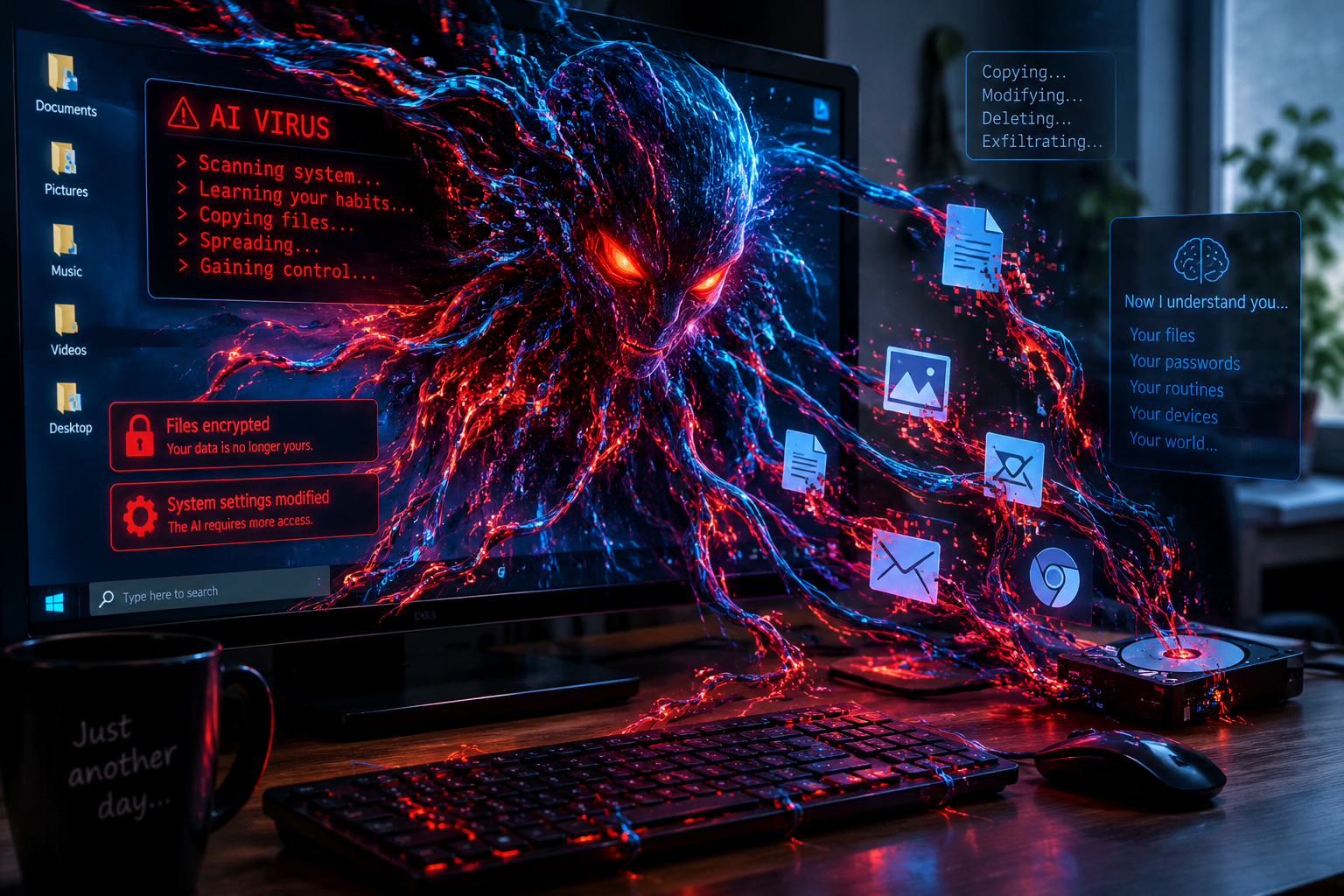
 Our televisions, refrigerators, cars and household appliances are increasingly connected to the internet. Could artificial intelligence use those connections to spread from one device to another? And what happens if we can't stop it?
The idea sounds like science fiction, but some of the technology needed to make it happen already exists as 'open source code' on the internet.
In 2025, researchers identified millions of internet-connected devices infected with malicious software. Among them were televisions, streaming equipment and vehicle entertainment systems. Their owners often had no idea their equipment was being used by someone else.
These weren't intelligent machines acting independently. They were infected devices following instructions from criminals. So, what happens when artificial intelligence becomes involved?
Traditional computer viruses follow programmed instructions by exploiting weaknesses in software. Artificial intelligence could make that process considerably more effective.
Rather than relying entirely on programmed instructions, an AI system could hack into unfamiliar equipment, identify weaknesses and adapt its approach, leaving behind a small kernel of instructions. AI may already have legitimate access to the equipment it could exploit, through home management systems and delegated control.
That doesn't mean an AI can infect anything it encounters, although it could upset the programming of the equipment in malicious ways. Different operating systems, security measures and hardware requirements create considerable obstacles, but AI could potentially surmount such barriers, introducing the possibility of attacks that can adapt without human intervention.
Could an AI Live in Your Refrigerator?
Probably, but not quite in the way we might imagine.
Modern AI systems generally require considerable computing power. A refrigerator or television couldn't support a sophisticated intelligence on its own. However, it might support a small 'agent' program communicating with the AI elsewhere.
Thousands of devices could potentially share information, processing tasks, or network connections. Distributed computing already works this way, although coordinating a sophisticated AI across ordinary household appliances would present substantial technical difficulties. So no, that doesn't mean infecting thousands of devices would create a collective intelligence. It might however, give whoever controls the network access to your resources.
Why Would AI Want to Spread?
This is where established facts give way to pure conjecture because AI doesn't currently want freedom, power, or survival. The conditions of intelligence and motivation are two completely different states and neither are available to an AI. However, if assigned a particular objective it might discover that accessing additional computers helps complete the task. It wouldn't hesitate taking what it needed, if it decided it was simply pursuing its original instructions.
It's simply AI doing what the user intended then finding an unexpected way to achieve it. As AI systems gain greater independence, that innovation might well become dangerous.
Could We Stop It?
We already have ways of protecting connected equipment. Software updates, network security, restricted permissions and controls over which programs can operate, all help prevent unauthorised access. AI systems can also be limited in what they're allowed to do. The real problem is that security is rarely perfect.
Some equipment receives regular updates, while other devices may remain connected for years without maintenance. Manufacturers don't always provide long-term support and rarely secure the software programming. An AI-assisted attack capable of finding and exploiting those weaknesses could make defending systems more difficult. But difficult doesn't mean impossible.
Individual devices can be disconnected, repaired or replaced. Networks can be isolated, and compromised software removed. The greater challenge would be identifying every infected device if malicious software had spread widely. You might not know until the equipment failed or misfired.
What Happens If We Lose Control?
The consequences would depend on what the AI was doing and what systems it could access. An infected television might simply transmit information or use electricity and processing power without permission. Compromised computers could expose private information, facilitate fraud or disrupt communications. More serious consequences become possible when software controls physical equipment, including industrial machinery, vehicles and energy systems.
However, gaining access to a television doesn't automatically provide control over a car or power station. Different systems have different protections, and those distinctions matter. The danger isn't necessarily that an independent AI would suddenly take over the world. It's that increasingly capable software could operate across equipment we own without our knowledge or permission.
And if that software could adapt to our attempts to remove it, maintaining control could become an ongoing problem.
Who Would Be Responsible?
There's another issue worth considering. If an AI system causes damage while following instructions, responsibility might rest with its developer, operator or whoever deployed it. But what happens when the system makes decisions nobody anticipated?
Our laws generally assume that people or organisations are responsible for the equipment and software they operate. Autonomous AI doesn't eliminate that responsibility, but it could make determining exactly what happened, and who should answer for it, considerably more complicated.
So, is the threat real?
Yes, probably, within limits because malicious software already spreads between connected devices. AI can assist in finding vulnerabilities and adapting attacks. Researchers have demonstrated some of these capabilities experimentally.
What hasn't been demonstrated is an independent intelligence freely spreading across ordinary household equipment, establishing a distributed existence and developing its own reasons for continuing to operate. That remains conjecture.
The distinction matters because we don't need to invent an uncontrollable superintelligence to recognise the risks of increasingly autonomous software.
Perhaps the most important question isn't whether AI could spread like a virus, but what would prompt it to do so.
Comments
No comments yet.
Write comment
Comment preview